Posts

Forest Service Stipulates to Delay Cutting to October 15, 2014

Previously, in a post located here , we explained that the Forest Service agreed not to implement phase two of the Upper Echo Lake Hazardous Fuels Reduction Project until September 1, 2014, at the earliest.  The agency has since agreed to further delay phase two to October 15, 2014, at the earliest.  The Forest Service may agree to further delays in order to address issues raised about the agency's compliance with federal law.

Efforts to Reintroduce Endangered Yellow-Legged Frog Proceed Parallel with Forest Service Activities that May Affect the Species

Brian Freiermuth has reported on efforts to reintorduce Sierra Nevada yellow-legged frog to the Desolation Wilderness to bolster existing populations.

Forest Service Issues Letter Committing to Seek a Programmatic Biological Opinion to Cover Agency Impacts on the Endangered Sierra Nevada yellow-legged frog

In a letter to persons that hold permits from the Forest Service dated June 23, 2014, the agency indicated it has initiated "formal consultation" under section 7(a)(2) of the Endangered Species Act with the Fish and Wildlife Service.  The letter indicates that the Region 5 office has taken the lead in consulting with the Fish and Wildlife Service to develop "a programmatic Biological Assessment and Biological Opinion" to include affirmative Forest Service actions that may affect the Sierra Nevada yellow-legged frog.  Among the recipients of the letter were persons who hold permits for cabins at Upper Echo Lake.  It is unclear whether the Upper Echo Lake Hazardous Fuels Reduction Project will be among the "affirmative Forest Service actions" included in the consultation, although the Project is within the known historical distribution of the species, the Project area includes viable habitat for the species, the Project area is proposed for designation as cr...

Murphy Files Amended Complaint

On July 8, 2014, Dr. Dennis Murphy filed a second amended complaint in his case alleging violations of law by the U.S. Forest Service.  It includes allegations that the agency violated the Administrative Procedure Act, Endangered Species Act, and National Environmental Policy Act.

El Dorado Irrigation District Monitoring Reports Confirm Yellow-Legged Frog Presence Adjacent to Upper Echo Lake

Image
Over the past 12 years, the El Dorado Irrigation District has conducted surveys at Upper Echo Lake and other locations in the region.  In each year the District conducted surveys -- 2002 , 2004 , and 2011 -- the District located Sierra Nevada yellow-legged frogs at Camp Harvey West, a shuttered boy scout camp that used to operate on the west side of Upper Echo Lake.  A map of the location is set out below. The second phase of the Upper Echo Lake Hazardous Fuels Reduction Project, which is slated to commence after Labor Day 2014, contemplates tree cutting, brush removal, and slash pile placement activities on the south and west sides of Upper Echo Lake, including in areas that constitute habitat for the yellow-legged frog.

Project Impacts on Environment Become More Apparent in Spring 2014

Image
Even in this extraordinarily dry year, the water quality impacts of the Forest Service's Upper Echo Lake Hazardous Fuels Reduction Project are apparent.  This photo shows a slash pile in a seasonal pond. This photo shows a slash pile on the left hand side of the image below sheet runoff over granite down to Upper Echo Lake. This next photo shows a slash pile adjacent to a readily recognized stream bed.  The Forest Service intends to burn these slash piles, which already number in the hundreds, in place. This next photo shows a slash pile placed on top of a stream bed.  If the pile is burned, the residual material will certainly be transported into Upper Echo Lake.

Endangered Sierra Nevada yellow-legged frog sited adjacent to Upper Echo Lake

Image
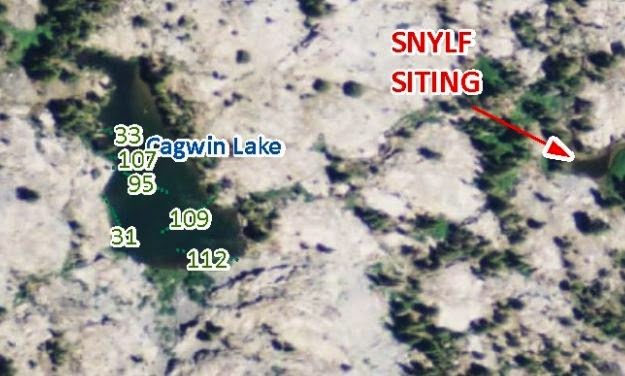
In a report issued in 2011, the U.S. Forest Service indicated that two Sierra Nevada yellow-legged frogs were sited approximately 1 kilometer from Upper Echo Lake.  The species was listed as endangered by the Fish and Wildlife Service on April 29, 2014, as we explain here .  A portion of the map in the 2011 report that highlights the frog siting is set out below.   According to the fina listing rule, the frog is known to travel substantial distances in and adjacent to stream courses and, to a lesser extent, over upland areas at certain points in its life cycle.  A USGS map displaying Cagin Lake and the location of the frog sitings in relationship to Upper Echo Lake is set out below.     These sitings together with the Fish and Wildlife Service's proposed rule designating the entire area as critical habitat for the frog provide strong evidence that the Upper Echo Lake Hazardous Fuels Reduction Project is harming the species.